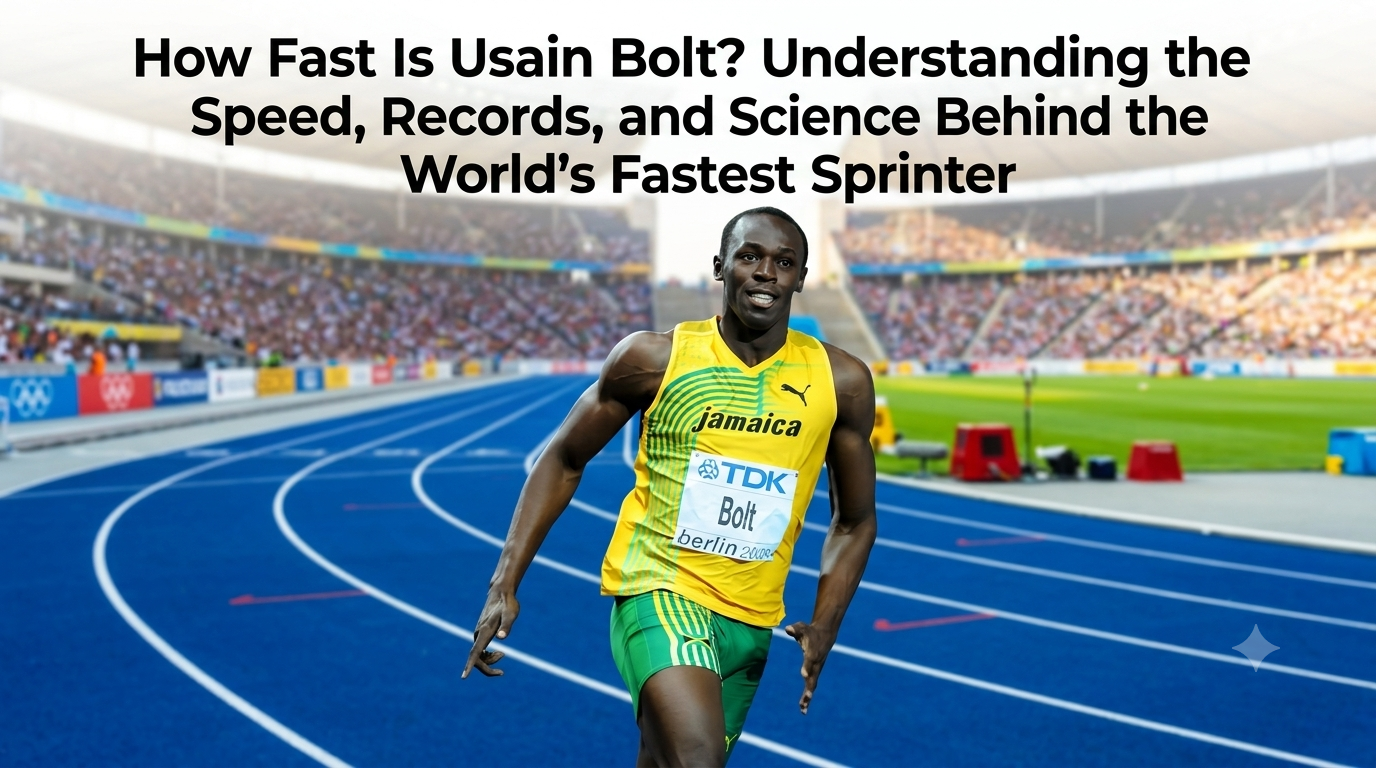
The question “how fast is Usain Bolt?” His records keep drawing attention, standing as some of the most remarkable accomplishments in contemporary athletics.His world record-winning performance in the 100-meter race at the 2009 IAAF WorldChampionships in Berlin saw Bolt finishing in an incredible 9.58 seconds. His top estimated speed was around 44.72 km/h (27.8 mph). Not many sportsmen in the history of the world had garnered such immense world attention as Bolt has done over the years.
Popularly known as “The Fastest Man in the World”, Bolt’s exploits in 100 and 200 meters races have expanded our notion of what is possible in human speed.With an immense stride, tremendous speed, and unwavering belief, he is without doubt, one of the most popular sportsmen of this era.
While Bolt’s speed might be just a number at face value, it is comprised of a whole multitude of variables including; reaction time, acceleration, stride length, stride rate, technique, muscle strength and race strategy. It was a potent and perfect fusion of these qualities, both physical and training, which ultimately deliveredBolt unprecedented glory, and it is in this article we take a look at the science behind the Usain Bolt speed, the importance of his world record achievements, the factors which influenced his excellence and what we can learn about the human potential of an athlete from the legendary runner.
What Readers Need to Know First About Usain Bolt’s Speed
When you say “how fast is Usain Bolt” you’re picturing the maximum velocity during his sprint but it’s really not just this because as we see in sprinting everything is changing all the time.
A 100-meter sprint is divided into different phases:
- Reaction and starting phase
- Acceleration phase
- Maximum velocity phase
- Speed maintenance phase
- Finishing phase
However Bolt didn’t necessarily win races just because he got out of the blocks the quickest. Indeed his reaction times are sometimes not as good as his rivals. Bolt’s superiority was based on his greater initial acceleration, greater leg length, and his better maintenance of high speeds throughout the last segment of the race.
One other thing is thatBolt did not operate at maximum speeds for a sustained period.
No human can operate at the peak speed over the course of a race due to a decline in the effectiveness of muscle fibres, as they become fatigued, in terms of power generation and co-ordination. This is not to undermine Bolt’s abilities; it simply means that his excellence is to be found not only in the highest velocity that he can reach, but also in the ability to reach very high speeds and sustain that better than anybody else.
The Fundamentals of Sprinting Speed
How Is Sprinting Speed Measured?
In track and field, speed is determined by dividing the distance covered by the time taken. In simple terms:
Speed = Distance ÷ Time
For a 100-meter race, an athlete’s average speed is calculated across the entire distance. Since Bolt ran 100 meters in 9.58 seconds, his average speed was approximately:
About 37.58 km/h — roughly 23.35 mph.
However, his peak speed was much higher because he accelerated throughout the race before reaching maximum velocity.
This difference explains why the answer to “how fast can Usain Bolt run?” depends on whether someone is asking about average race speed or maximum sprint speed.
Usain Bolt’s Fastest Recorded Performance
The most famous example of Bolt’s speed came at the 2009 World Athletics Championships in Berlin.
During the men’s 100-meter final:
- Distance: 100 meters
- Time: 9.58 seconds
- Average speed: About 37.58 km/h
- Peak speed: About 44.72 km/h
- Wind assistance: Legal tailwind conditions
This was also an improvement on the previous world record he set in the 2008 Beijing Olympics of 9.69 seconds. Most strikingly was that Bolt did not just break the world record, he smashed it! It is a great improvement to run faster and faster but not as significant.
Why Is Usain Bolt So Fast?
Exceptional Stride Length
One of the biggest reasons for Bolt’s success was the incredibly long stride he possessed. In his 100m world record race, Bolt needed one less stride to reach the finish line than some of the men in the lane next to him. He was about 6ft 5in, which gave him a considerable stride length, helping him run more ground each time he extended his legs. Being tall doesn’t necessarily make you a world-beating sprinter however, and longer stride needs to be supplemented by a burst of speed and quick legs.
Powerful Acceleration
This, arguably, is one of the most critical elements in a sprint race, as the ability to accelerate efficiently provides a competitive edge. WhileBolt’s size and long limbs might have made it uncertain to some experts as to whether he’d be able to accelerate faster than smaller rivals, explosive strength and perfect technique negated this possible disadvantage. His ability to accelerate rapidly from the blocks up to top speed became a key competitive advantage.
Efficient Running Technique
Perfect Biomechanics Every stride and every movement during a sprint needs to be technically perfect. A minor improvement in your stance, footstrike, arm carriage, or body posture at maximum speed can make a huge difference. Bolt was relaxed when running – at full speed This is one area where a lot of sprinters really tighten up at full sprint – making their movements very inefficient.
Usain Bolt’s Major Records
Usain Bolt is best known for three world records:
100-Meter World Record
Bolt’s 9.58-second performance remains the fastest officially recorded 100-meter sprint in history.
This record established him as the benchmark for world’s fastest runner discussions.
200-Meter World Record
Bolt also holds the 200-meter world record with a time of 19.19 seconds, achieved at the same 2009 World Championships.
The longer sprint demonstrated his ability to maintain exceptional speed over greater distances.
4 × 100-Meter Relay Record
At the 2012 London Games he was a member of the Jamaican team that set a new world record of 36.84 seconds for the 4×100-meter race. His successes with the relay team revealed his value to his teammates as well as to himself.
The Science Behind Human Sprint Speed
Elite sprinting is a combination of several physical and biological factors, including sports biomechanics principles.

Muscle Power
The athletes require the help of the muscle fibers that react faster or called as fast-twitch muscle fibers. The muscle fiber has the ability to bring forth instant motion.
Reaction Ability
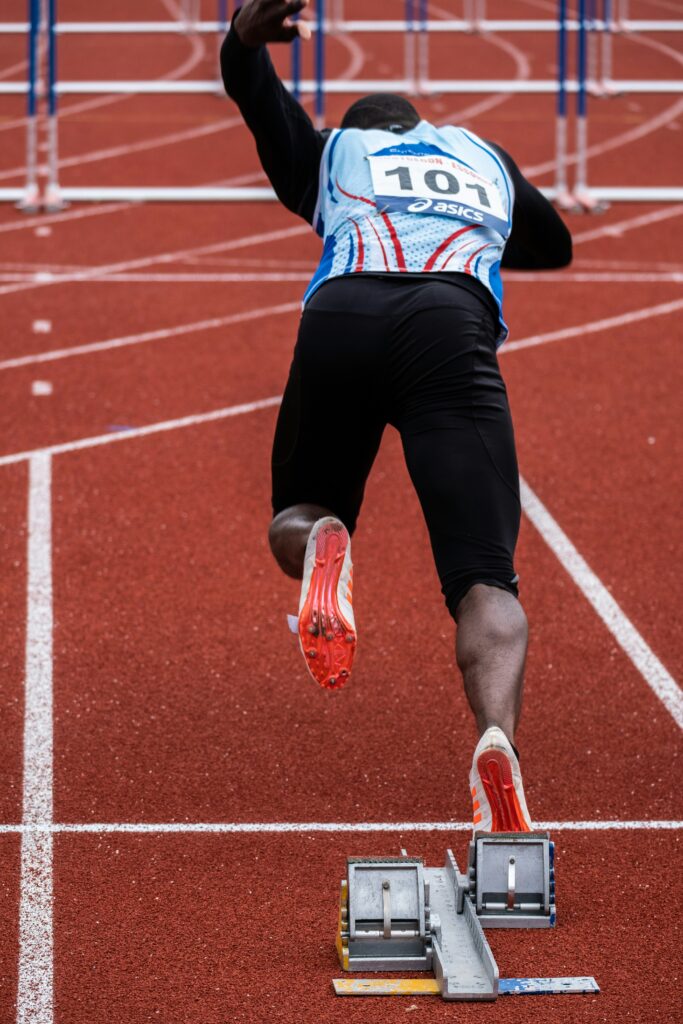
Race start is based on reaction time of an athlete toward the starting gun. Even Bolt was not the quickest starter in each and every race but he was the fastest runner, so he could make up little by little at the start of the game.
Stride Frequency and Length
Sprint speed depends on two main components:
- How long each stride is
- How quickly each stride occurs
Many athletes specialize in one area, but Bolt combined both effectively.
Body Mechanics
Efficient movement reduces wasted energy. Elite sprinters develop precise coordination between their legs, arms, and core muscles to maximize forward movement.
Expert Insights and Industry Knowledge About Usain Bolt’s Speed
Sports scientists and experts in the sport will cite it as an exceptional cocktail of genetics, training, biomechanics, and competitive nous. Not everyone is built for raw speed, of course, but fewer people still have the kind of physical gifts and efficiency in motion to excel in 100-meter sprinting at its absolute highest level. What is really exciting about Bolt’s career is that he bucked conventional wisdom about what makes a world-class 100-meter sprinter.
Prior to his emergence, many observers thought that elite 100-meter runners had to have small, dense frames that allowed them the highest possible acceleration.
Bolt showed how a tall athlete could accelerate like the best of the rest when he had his talent augmented with considerable strength, technique and co-ordination.
One element many researchers who study Usain Bolt’s sprinting speed look at is his performance after he’s reached top speed. As many as two to three meters per second of speed is lost by most sprinters in the last 20 meters of a 100-meter race due to fatigue. His long legs and efficient motion meant he slowed down far less than most of the other sprinters on his day.
He also had the mental ability to remain relaxed during competition. Sprinting can be one of the hardest physical endeavors imaginable, and excessive muscular tension will cause one to perform poorly even with perfect conditioning. However Bolt was able to relax his body and maintain efficient form during all of his biggest races.
How Fast Was Usain Bolt Compared With Other Sprinters?
It is difficult to compare athletes in different time periods, because track conditions, technology, training techniques and levels of competition have continuously evolved. Still, Bolt’s accomplishments are widely regarded as among the highest standards in sprinting. Prior to Bolt, there were some other athletes with the legendary fame on the short distance races, such as Carl Lewis and Maurice Green.
Both athletes played important parts in the innovation of modern sprinting.
Bolt had an advantage because he could unite …
- Exceptional top speed
- Long stride efficiency
- Strong acceleration
- Race awareness
- Consistency in major competitions
When discussing the fastest human ever, Bolt is usually considered the leading example because of his official world records and Olympic achievements, much like the inspiring journey covered in Jodi Lynn Calaway.
The Training Behind Usain Bolt’s Speed
Although natural ability played an important role, Bolt’s achievements were also the result of structured professional training.
Sprint Technique Training
A major part of elite sprint preparation involves improving running mechanics. Athletes practice:
- Starting position
- Acceleration technique
- Maximum velocity running
- Body posture
- Arm movement
- Foot placement
Small improvements in technique can create measurable differences in race times.
Strength and Power Development
The capacity to generate a large amount of force in a short period of time is a critical factor in sprint speed. The power of athletes to create this force has been developed through a variety of exercises, including power training, resistance training, plyometrics, and speed training. Ultimately, the intent of these training methodologies is not to build more size on the muscles, but rather, to develop force in the shortest possible amount of time.
Recovery and Injury Prevention
Recovery and Injury Prevention is supported by effective sports recovery techniques.
High-level sprinting places significant stress on muscles and joints. Professional athletes carefully manage recovery through:
- Rest periods
- Mobility exercises
- Physical therapy
- Nutrition planning
- Sleep management
Maintaining physical health is essential because even minor injuries can affect sprint performance.
Important Considerations When Understanding Sprint Speed
Although Usain Bolt’s speed is extraordinary, it is important to understand that sprint performance involves many variables.
Weather Conditions
Surface effects on sprinting sprints. Any number of physical conditions may impact your ability to run faster. Among them: the speed of the wind, temperature, and surface quality. Wind may even serve you as long as your support wind comes in a reasonable range; too much wind does not allow an award to set a new world record.
Competition Environment
Elite athletes often perform better when competing against strong opponents. Competition creates motivation, improves focus, and encourages athletes to push their limits.
Equipment and Technology
Today’s sport is supported by the enhanced quality of track and equipment, by sports medicine, research on human capabilities and analysis instruments for performances.
Yet, this is not enough for the genesis of a champion; raw natural skill and technical mastery are still decisive.
Real-Life Applications of Understanding Human Speed
Although most people will never reach professional sprinting levels, studying athletes like Usain Bolt provides valuable lessons beyond athletics.
Improving Personal Fitness
Understanding sprint mechanics can help everyday athletes improve:
- Running efficiency
- Explosive power
- Coordination
- Athletic performance
Short sprint exercises are often used in fitness programs because they improve cardiovascular capacity and muscular strength.
Sports Training
Many sports require short bursts of speed, including:
- Football
- Basketball
- Rugby
- Tennis
- Baseball
Athletes in these sports study sprint training methods to improve quick movements and acceleration.
Sports Science Research
Bolt’s performances remain important in the research of biomechanics, human performance and sport development. Researchers study elite athletes to gain more information about the mechanisms which the human body employs in generating and maintaining such high speeds.
Common Questions Readers Have
How fast is Usain Bolt in mph?
Usain Bolt’s top recorded speed during his 100-meter world record race was approximately 27.8 miles per hour (44.72 kilometers per hour).
Does Usain Bolt remain the fastest person alive?
Usain Bolt currently holds the official 100-meter and 200-meter world records. That is just to mention two examples as other individuals may be incredibly quick, but are not able to match the benchmarks set by Usain Bolt.
How many steps did Usain Bolt take in his fastest race?
A good portion of the 9.58-second run was comprised of the roughly 41 strides Bolt was able to take on his way to the world record – significantly less than most because his strides were so much longer.
Could humans become faster than Usain Bolt?
Sports scientists have predicted that with more training, improved diets and new technology we may well be seeing further progress in sprint times for future generations. Yet to overcome Bolt’s current records, requires a perfect, and thus exceptionally rare, mix of physiological and biomechanical skills.
How fast can an average person run compared with Usain Bolt?
If a typical recreational runner raced against an elite sprinter, they would likely come in very far behind. Factors like genes, conditioning, skills and years of focused practice result in that large gap.
Key Takeaways
Usain Bolt’s speed represents one of the greatest achievements in sports history. His 100-meter world record of 9.58 seconds demonstrated an extraordinary level of human performance.
The answer to “how fast is Usain Bolt?” is not only about his maximum speed of approximately 44.72 km/h. His greatness came from combining acceleration, stride efficiency, technique, strength, and mental confidence.
His performance as Bolt has demonstrated the multiple factors contributing to an athlete’s achievement, and has showed how an individual may possess some physical attributes more than others and yet compete and win on the world stage as long as they possess enough dedication, expertise, injury control and experience on the competitive circuit. All these traits Bolt possesses in great measure and it’s, and no doubt will, be interesting for years to come what humans can reach physically.
Conclusion
Usain Bolt’s impact on the sprinting sport is truly phenomenal, as his sprint feats transformed an Olympic champion into the embodiment of speed and athleticism across the entire globe. At 9.58 for 100m, the Jamaica legend achieved a time the world has never before been able to reach at that speed while topping speeds of almost 45 kph.
Understanding how fast is Usain Bolt provides insight into much more than a number. It reveals the science of acceleration, biomechanics, training, and human potential.
Future sprinters might someday shatter his records, but between Usain Bolt’s size, speed, technique and charisma, few would argue he isn’t one of the fastest sprinters in the history of our planet.